

Guiding the Needle to the Deepest Layers of the Body
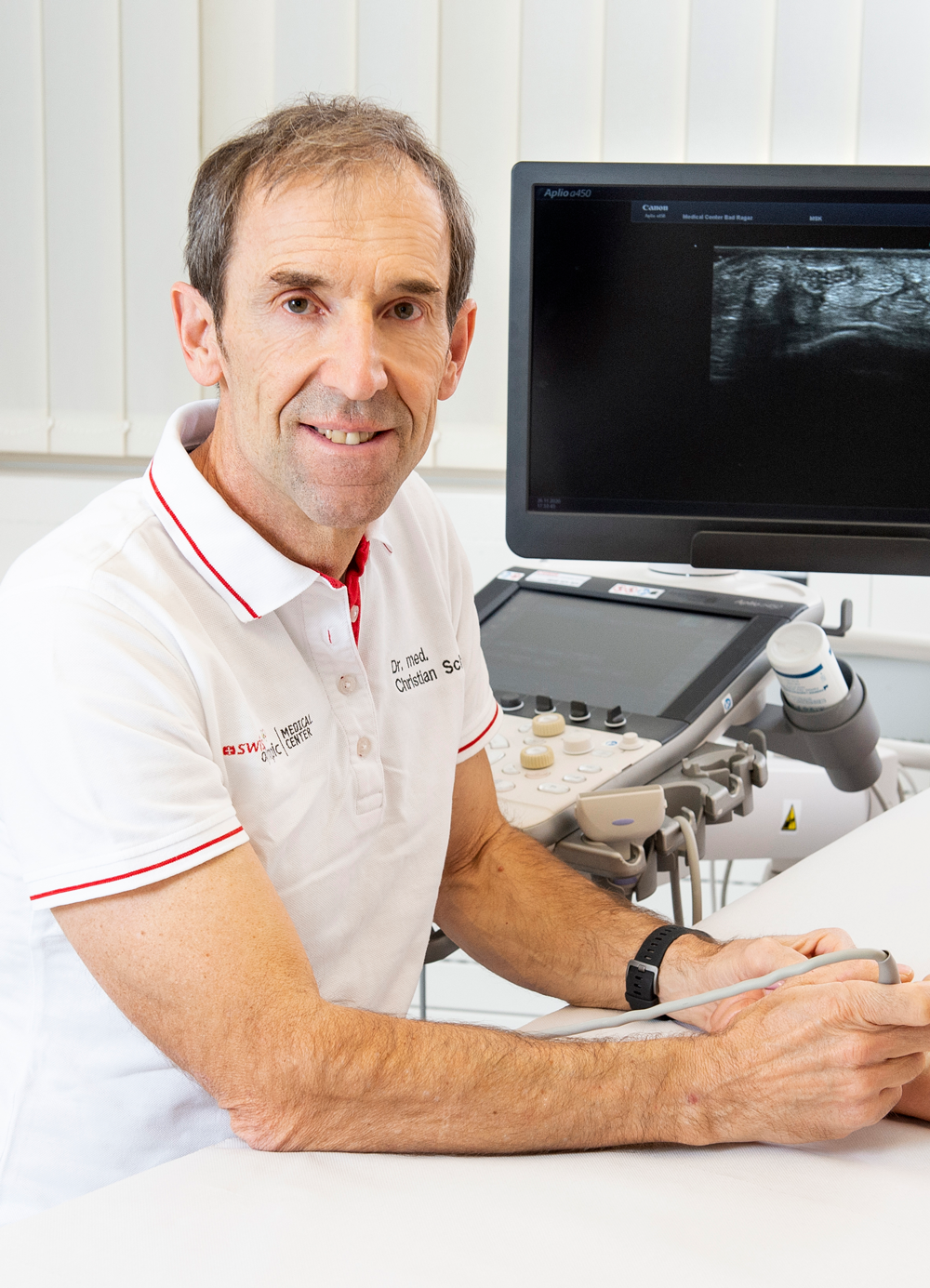
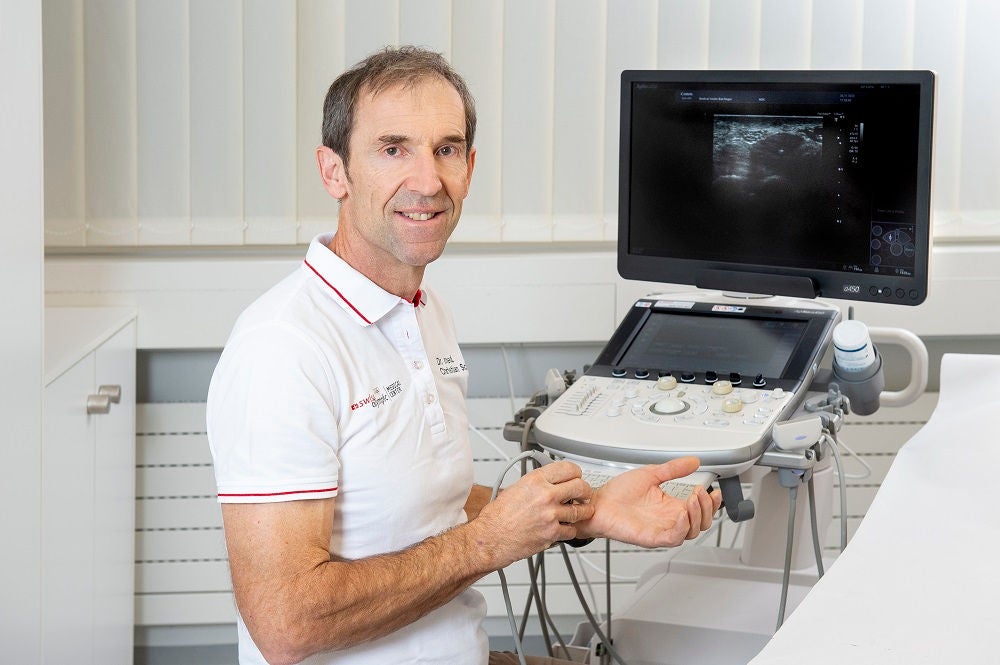
Dr. Christian Schlegel, head physician of the sports medicine department at the Swiss Olympic Medical Center Bad Ragaz, uses the Aplio a450 for diagnosis and treatment of musculoskeletal (MSK) injuries. The system’s unmatched image quality and beam function enable him to access the tiniest tendons and deeper layers of the muscles and will allow him to perform new types of interventions into the spinal facet joints, he told Visions.
Unveiling the smallest structures with high image quality
“The main reason I decided to buy the Aplio is the impressive image quality for MSK diagnosis,” he explained. “The second reason is that the needle guide, which is called the BEAM function, enables me to easily see the needle with a special enhancement function. That’s very helpful when I perform injections.”
When he chose the system, Dr. Schlegel focused on how it enables to see the nerves and guide the needles, as these are the two most difficult tasks when performing an intervention.
“I need very high image quality to see the right structures and then, when I do an injection, I need these additional tools such as BEAM and needle enhancement,” he said.
Since it was installed in December 2019, the Canon equipment has fully met and even exceeded the expectations. “I simply enjoy working with the Aplio a450,” he said. “I like the great images and the easy-to-use reporting function. I get a really good and detailed report, which I can seamlessly introduce into my patient’s history. I can also use the report when I talk to other physicians and patients, it’s a good reference.”


The Medical Health Center opened in 1957, the institute for sportsmedicine in 1998 and became an official Swiss Olympic Medical Center six years later. The center treats all elite athletes from juniors to regional and national levels, providing advice and support inter alia in the following areas: check-ups and performance diagnostics, optimization of physical and mental performance, injury prevention, management of strains, training and nutrition.
The Aplio a450 is particularly well suited for specific and complex proce-dures, such as special injections to the nerves or deep structures.
The hip can be particularly challeng-ing to access, especially in larger patients. “The deeper you are, the more difficult it is to get images. But with this system I made big progress. Compared to other machines, the Canon offers very good quality in the hip and deep layers,” he said.
Dr. Schlegel can perform more examinations with the Aplio a450, for example in the shoulder, the ankle, the Achilles’ tendon or the plantaris and patellar tendons.
He also uses the Aplio to guide a number of infiltrations and injections to treat tendinitis or peri-tendinitis for partial tears of the tendons in the ankle or the hip.
Some very small tendons and struc-tures were nearly impossible to see with previous equipment, Dr. Schlegel explained: “It was very difficult to find the infrapatellar branch of saphenous nerve with the machine we had before. But we did find it with the Aplio a450. It’s especially good to image this structure.”
The most spectacular case he treated with the Aplio a450 was a patient with chronic knee pain who underwent a block of the infrapatellar nerve. “The patient was pain-free for the first time in two years. By the second injection, the pain disappeared. It was very impressive what we could achieve with ultrasound control on the Aplio a450,” he said.
So far, Dr. Schlegel is the only special-ist in his institution using the Aplio a450, but this might change soon as colleagues are starting to notice the system’s potential for their field as well.
“Some time ago, I had an emergency patient and needed to call Dr. Küpfer from our angiology department to examine the vessels,” Dr. Schlegel said. “He was so impressed by the quality of my machine that he now wants to get one as well.”
Future applications with the Aplio a450
Dr. Schlegel wants to focus more on treating tendons and back problems and is convinced that this will be possible thanks to the Aplio’s high imaging quality.
He wants to offer injections into the spinal facet joints, which he now performs under x-ray control. “My intention is to do these procedures with ultrasound to diminish radiation exposure. I’ve attended courses on the topic but haven’t tried yet,” he said.
Moreover, Dr. Schlegel was impressed by the complete absence of technical issues during and after the installation of the Aplio 450. “I’ve been working with the equipment for nearly a year and haven’t had any technical problems. That was quite surprising because usually, with such sophis-ticated equipment, you would have issues. The Aplio is very reliable.”
The learning curve with the Aplio was easy and fast, about two weeks, Dr. Schlegel concluded: “You can always improve some details. But for daily practice, it works.” //
An interview by:
Mélisande Rouger - Independent Journalist
Social Media


